


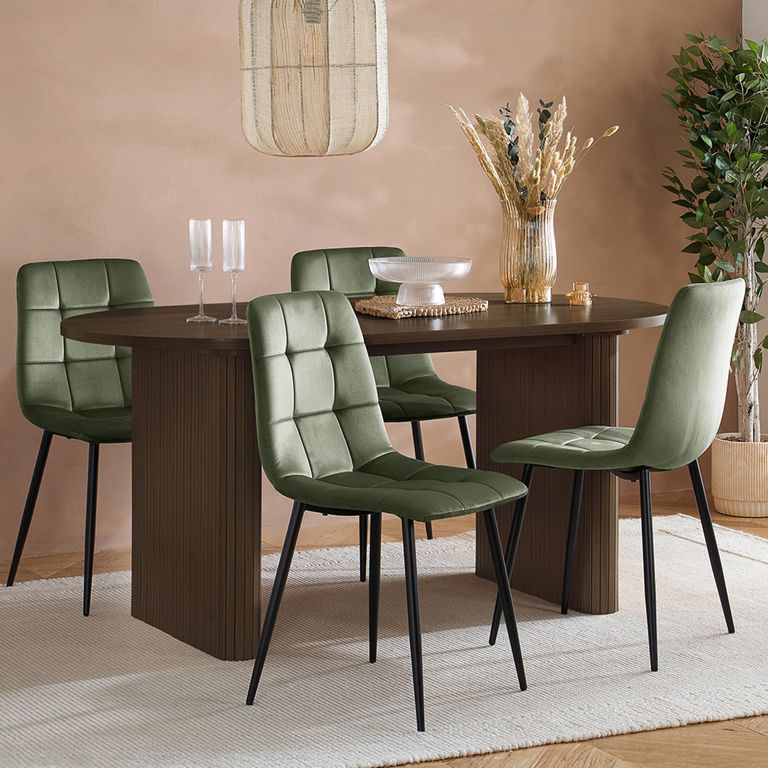
There are two ways to furnish a dining room. You can choose a complete set in which the table and chairs have already been paired, or you can buy the table first and select the seating yourself.
A dining set is the simpler route. The proportions and finishes have been brought together for you, and you can see the finished arrangement before ordering.
Buying separately gives you more control. You might prefer an oak table with upholstered chairs, want armchairs at the ends, or need unusually narrow seating to fit between the table legs.
Neither method is automatically better value or more stylish. The right choice depends on how certain you are about the look, how particular you are about chair comfort and whether the room has any awkward measurements.
Why complete dining sets are easier to buy
A complete set removes several decisions at once.
You do not need to wonder whether the chairs are the right height for the table or whether their legs will look strange beside the base. The manufacturer or retailer has already created a combination intended to work together.
This is helpful when furnishing a dining room from scratch, particularly if you want a coordinated result and do not enjoy comparing individual pieces. The product photography gives you a clear idea of how the complete arrangement will look.
A set can also make budgeting easier because the table and seating are priced together. In some cases, the package may cost less than buying the same or similar pieces individually. This is not guaranteed, so compare the actual contents and prices rather than assuming every bundle includes a saving.
Delivery may be easier to coordinate too. The table and chairs form one order instead of arriving from different ranges or suppliers at separate times.
The chair is the reason many people buy separately
It is quite common to love a dining table but feel less certain about the chairs supplied with it.
A table is judged by size, shape, finish and construction. A chair also has to fit the person sitting in it. Seat depth, cushioning, back angle and width can make one design comfortable for one household and unsuitable for another.
Buying the dining table and dining chairs separately lets you choose each on its own merits. You can find the table that fits the room, then select chairs that people genuinely enjoy sitting on.
This is especially useful when the dining table doubles as a place for homework, working from home or long family meals. A chair that looks perfect but becomes uncomfortable after twenty minutes is not a good match for the way the table is used.
Separate buying also allows different types of seating around one table. You might choose two armchairs at the ends, armless chairs along the sides or a bench against the wall.
Matching does not have to mean identical
A dining set creates an immediately coordinated look, but buying separately does not mean the room will look mismatched.
The table and chairs only need something in common. It could be a similar wood tone, the same leg colour, a repeated curve or a fabric that connects with another part of the room.
An oak table with grey upholstered chairs can feel balanced because the warm timber and soft fabric complement one another. A dark table with chairs on black legs can look intentional even when the seats are a different colour. A glass or ceramic tabletop may work with chairs that repeat the metal finish used in its base.
Trying to match two wood finishes almost—but not quite—perfectly can be harder than choosing a deliberate contrast. If the table is natural oak, chairs in a painted, upholstered or clearly darker finish may look more considered than a slightly different oak effect.
A room often feels more natural when it has variation rather than one material repeated everywhere.
Separate pieces need careful measuring
A complete set reduces the risk of a basic size mismatch, although you should still check the room measurements.
When buying separately, begin with the height from the floor to the tabletop and then measure the lowest point underneath. A deep apron can reduce knee space even if the table itself is a standard height.
Compare this with the chair’s seat height. There should be enough space for the diner’s thighs without making the tabletop feel too high.
Next, measure between the table legs. The tabletop may appear wide enough for three chairs, but those chairs still have to fit within the usable opening. Use the maximum chair width, including arms or the widest part of the back.
Armchairs need another check: the arms may be too high to slide beneath the table. Swivel chairs need room to rotate, and angled backs can project further than expected.
These measurements are manageable, but they cannot be skipped. A successful mixed arrangement feels effortless precisely because the practical work was done first.
A dining set still needs to fit the room
Buying a coordinated set does not guarantee that the complete arrangement suits your dining area.
Retail photographs usually show the chairs tucked neatly in. In daily use, chairs are pulled out, people sit behind them and others may need to walk past. Measure the room with the chairs in use, not only the table standing empty.
A set described as a six-seater tells you how many chairs are included or how many people it is designed to accommodate. It does not tell you whether six adults will feel comfortable in your room.
This is particularly important with broad upholstered chairs. A table that works with six slim wooden seats may feel crowded with six wide, curved-back chairs.
If space is tight, compare dining sets for four rather than squeezing a larger arrangement into the room simply because you occasionally host more guests.
What about extending tables?
An extending table adds another decision. It may be used with four chairs most days and six or eight when opened.
An extending dining set gives you a ready-made seating combination, but think about where the extra chairs will live while the table is closed. Keeping every chair around a smaller tabletop may make the everyday arrangement feel crowded.
Buying separately allows you to purchase the number of chairs used daily and add folding, stackable or occasional seating elsewhere if appropriate. Alternatively, you might keep two matching chairs against a wall or in another room.
Check how the table legs behave when extended. If they remain in their original position, the added tabletop length may not provide as much clear legroom as expected. If the legs move outward with the extension, the additional chairs may fit more naturally.
Always measure the room using the fully extended dimensions. The table may open successfully but leave no room for the extra diners to pull out their chairs.
Benches offer a useful middle ground
A bench can make a dining arrangement feel less formal and may allow seating to be tucked beneath the table when not in use. It is especially useful along a wall where individual chairs would need more space to pull out.
Complete dining sets with benches take care of the relationship between the bench and table. Buying separately gives you more freedom, but bench length and height must be checked carefully.
A bench does not guarantee that more people will sit comfortably. Adults still need enough width, and climbing into the middle can be inconvenient if the bench is enclosed by walls or other furniture.
For families, a bench can be flexible and sociable. For anyone who needs strong back support or arms when getting up, individual chairs may be more suitable.
Which approach gives better long-term flexibility?
Buying separately makes future changes easier. A worn set of chairs can be replaced without changing the table, and the table can remain if your preferred seating style changes.
You can also build the arrangement gradually. A good table may be purchased first, followed by chairs once you find the right design.
The challenge is consistency. If you intend to buy additional matching chairs later, the same range, finish or fabric may no longer be available. Colour can also vary between production batches.
A complete set gives you everything together, but replacing one damaged chair several years later may present the same difficulty. Check whether the chairs are also available individually if future replacement matters to you.
Budgeting beyond the package price
A dining set makes the total cost visible from the beginning. When buying separately, it is easy to focus on the table price and underestimate what four, six or eight chairs will add.
Calculate the complete arrangement before making either purchase. Include extra end chairs, a bench or occasional seating if those are part of the plan.
A lower-priced set is not automatically better value if the chairs are uncomfortable or the table is the wrong size. Equally, mixing pieces does not need to be expensive. A simple table paired with carefully chosen chairs can look personal without requiring every item to be premium.
Value comes from using the complete arrangement comfortably, not from obtaining the greatest number of pieces for the lowest total.
So, should you buy a set or choose separately?
Buy a complete dining set when you like both the table and chairs, want a coordinated result and prefer a simpler decision. It is a sensible option for furnishing a room quickly and seeing the full cost at once.
Buy separately when chair comfort is a priority, the table has unusual dimensions or you want to mix materials, colours and seating styles. It is also the better route when you already own part of the arrangement.
Whichever way you buy, do not let appearance settle the decision on its own. Check the table height, space between the legs, chair width and clearance around the entire setting.
The best dining room is not the one in which every piece matches perfectly. It is the one where people can sit comfortably, move without squeezing past each other and stay at the table for as long as the conversation lasts.