


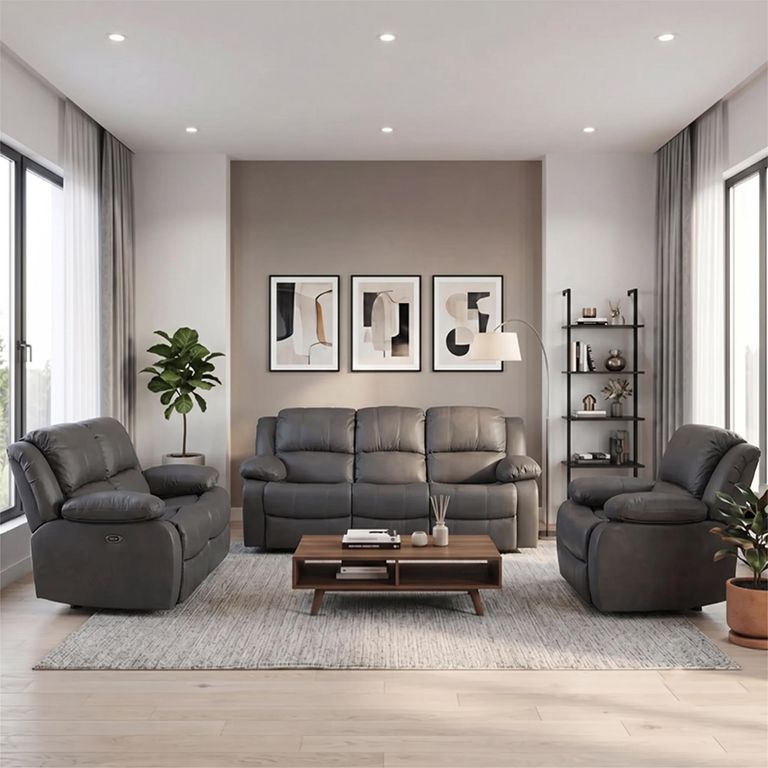
A small living room rarely has only one purpose. It may be the television room, play area, reading space and the place where visitors sit—all within a few metres of floor.
The answer is not to push every piece of furniture tightly against the walls. Nor is it to fill the room with undersized furniture that nobody finds comfortable. A successful layout begins with movement: how people enter, cross and use the room when it is busy.
Before buying anything new, measure the room and mark the position of doors, windows, radiators, sockets and fixed features. Then compare those measurements with the exact dimensions of your chosen living room furniture.
Draw the room as it really is
Include the features that make the room awkward. A chimney breast, deep windowsill or door that opens into the room may remove more usable space than expected.
Record:
- Wall-to-wall measurements
- Door widths and opening directions
- Radiators and fireplaces
- Window height and projection
- Television and power points
- Alcoves and chimney breasts
- The route furniture must take during delivery
A paper sketch is enough. The point is to stop planning as though every wall is uninterrupted.
Use masking tape or flattened cardboard to mark furniture footprints on the floor. Leave it in place for a day if possible. Walking around a taped rectangle reveals problems that a product photograph cannot.
Decide what the room is mainly for
The main activity should determine the strongest part of the layout.
If the household watches television together most evenings, establish the seating and screen relationship first. If conversation matters more, arrange seats to face one another rather than placing every chair in a straight line towards the television.
A family room may need clear floor space for play, while a quiet sitting room might work better with two chairs and a compact sofa.
Trying to give every possible activity equal importance usually produces clutter.
Choose the sofa by usable seating, not appearance alone
A bulky two-seater can occupy as much room as a more streamlined three-seater while providing less useful seating. Look at overall width, arm thickness, seat depth and back height.
Compact sofas with narrower arms can make efficient use of a short wall. However, shallow seats do not suit everybody, so comfort still matters.
A corner sofa can work well when it follows the shape of the room and replaces several separate seats. It can also become an obstacle if its chaise projects across the natural route to a door.
Mark the entire footprint, including recliner movement or the open bed size of a sofa bed. Do not measure only the closed furniture.
Keep one obvious route through the room
People should not have to turn sideways around a coffee table or step between the television and sofa every time they enter.
Identify the normal route from the doorway to the main seat, window or adjoining room. Keep it as direct and uncluttered as the space allows.
There is no single perfect walkway measurement for every home, but the test is straightforward: can someone cross the room comfortably while another person is seated?
Remember that drawers and cupboard doors temporarily occupy additional space. A TV unit fits only if its storage can be opened without hitting the coffee table.
Does a small room need a coffee table?
Not always.
A central coffee table is useful for drinks, books and remote controls, but it may consume the most valuable open area in the room. A round or oval design can be easier to move around where space is tight.
Alternatively, use small side tables that can be repositioned beside individual seats. Nesting tables provide several surfaces when visitors arrive and take up less room when stacked.
Choose according to the room’s routines. If the floor is regularly needed for children, exercise or a pull-out sofa bed, easily moved tables are more practical than one heavy centrepiece.
Positioning the television
Avoid choosing a TV unit by screen width alone. Check the base or feet of the television, the unit’s maximum load and the space required by other equipment.
Low TV units can keep a compact room from feeling visually crowded, but storage may be limited. A unit with doors can hide equipment and cables, provided there is ventilation and the remote-control signal can still reach the devices.
Consider glare from windows and the manufacturer’s recommended viewing conditions. Do not block a radiator or cover ventilation openings to achieve a symmetrical arrangement.
Wall mounting can free the top of the unit, but safe installation depends on the wall construction and should be carried out correctly.
Use height carefully
Tall storage makes use of vertical space but can feel imposing when several large pieces compete in one room.
A single bookcase may be more effective than multiple small cabinets. Closed storage at the bottom hides everyday clutter, while lighter display space above prevents the piece from appearing too solid.
Secure tall furniture according to its instructions, particularly in homes with children. Never assume its weight alone will prevent tipping.
Make every piece justify its footprint
In a small room, occasional furniture should solve a real problem.
A storage footstool can provide seating, a place to put your feet and somewhere to keep throws. A side table with a drawer can replace a separate storage basket. A sofa bed may remove the need for a permanent guest bed elsewhere.
That does not mean every object needs several mechanisms. Complicated furniture is not useful if its features are never used. Choose the simplest item that performs the required jobs well.
Test the layout before ordering
Mark the furniture on the floor and then imitate normal use:
- Sit where the sofa will be.
- Walk from the door to the window.
- Open the imaginary cupboard doors.
- Extend the sofa bed or recliner.
- Check whether a lamp can reach a socket.
- Consider how the furniture will enter the house.
A good small living room does not need to look empty. It needs to feel easy to use. When the route through the room is clear and each piece has a purpose, even a modest space can feel settled rather than squeezed.