


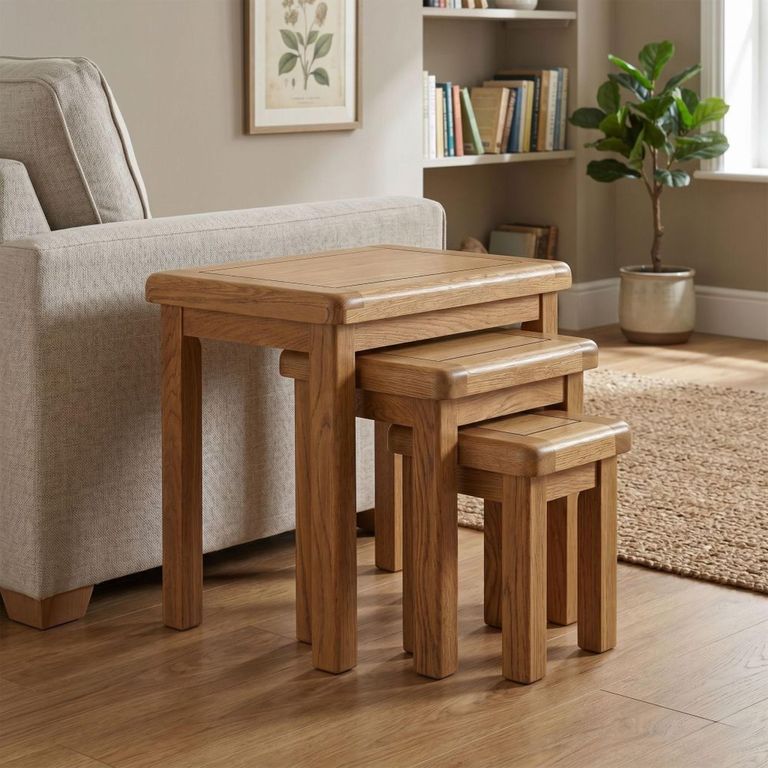
A side table gives one seat a permanent surface. A nest of tables gives the room several surfaces that can appear when needed and tuck away afterwards.
That sounds like a simple choice between fixed and flexible furniture, but the better option depends on how the living room is used. One household may need a lamp table that never moves. Another may need somewhere for three cups when guests arrive but wants the floor clear for the rest of the week.
The question is not which type offers more furniture. It is whether you want one table to stay in place or several tables to move around the room.
When a side table works best
A side table is useful when the same seat needs a surface every day.
It can hold a lamp, drink, book or remote without being moved around. Beside a sofa or armchair, it creates a settled arrangement and can balance another table at the opposite end.
Because it stands independently, you can choose the exact height and shape needed for one position. A narrow table can fit beside a sofa arm, while a broader one can fill the space between two chairs.
A side table is also the clearer choice when a lamp will remain plugged in. Moving nested tables around electrical cables is inconvenient and potentially unsafe.
Why a nest of tables is so adaptable
A nest of tables usually contains two or three tables of different sizes. The smaller pieces slide beneath the largest when not in use.
For most of the week, the set occupies roughly the footprint of one table. When visitors arrive, the smaller tables can be placed beside different seats.
This makes nesting tables useful in smaller living rooms where several permanent side tables would reduce the walking space. They can also replace the need for a large coffee table when the room needs to remain open.
The flexibility only helps if the tables are easy to separate and have somewhere sensible to go. Check the size of every table, not only the largest one shown in the main photograph.
Think about your normal evening
Imagine where drinks, phones and books usually end up.
If one person always sits in the same chair and wants a reading lamp beside it, a single side table is the more natural solution.
If several people use different seats or the furniture is rearranged regularly, a nest offers more options. One table can sit beside the sofa, another near an occasional chair and the smallest can hold snacks.
Do not plan only for guests. Furniture used twice a year should not make the room less comfortable every day. Choose for the household’s normal routine, then consider how well it adapts when people visit.
Height makes a difference
A side table should be easy to reach from the neighbouring seat. A top around the height of the sofa or chair arm often feels natural, although the ideal position depends on the furniture.
Too low, and drinks feel awkward to place down. Too high, and the table can look intrusive beside the seat.
Nesting tables come at several heights by design. This is useful when they serve different chairs, but the smallest table may be much lower than expected.
If a lamp will stand on the largest table, check the total height of the lamp and table together. A tall lamp on a high surface can shine directly into the eyes of someone seated nearby.
Surface area versus footprint
A single side table gives you one top, but that top can be generously sized. It may comfortably hold a lamp and leave room for a drink.
A nest divides the available surface across several smaller tops. When nested, only the largest is fully usable. Items placed on it may need to be removed before the smaller tables can slide out, depending on the design.
This matters if the main table will carry a lamp, plant or decorative objects. The set may be technically flexible but inconvenient to separate because its largest surface is always occupied.
Look at how the tables overlap. Some slide completely underneath; others remain partly visible in a stepped arrangement. A staggered design needs a larger everyday footprint but may leave more than one surface accessible.
Stability and weight
A larger side table may feel more stable because of its broader frame, but construction and floor level remain important.
Nesting tables need to be light enough to move while staying stable during use. Very small tables can be easier to knock, particularly on a thick rug or uneven floor.
If children or pets move quickly through the room, consider the shape and base. Rounded tops remove sharp corners, while splayed legs may extend beyond the visible edge and create a trip point.
Stone, ceramic and glass tops can make smaller tables heavier than they appear. This may improve stability but make frequent movement less convenient.
Use the manufacturer’s lifting and care guidance, especially for nested tables with removable tops.
Which is better in a small living room?
A nest usually provides more flexibility from one compact storage position. It is useful where surfaces are needed occasionally but open floor space is valuable.
A slim side table may be even more economical when only one surface is required. There is no benefit in storing three tables if two will never be used.
Measure beside the sofa rather than choosing from the room’s overall size. Check the position of the sofa arms, radiator, curtains and sockets. A round table can fit a tight corner more easily, while a square design may sit neatly against a wall.
If there is already a coffee table, consider whether a complete nest adds unnecessary surfaces. One well-positioned side table may be all the room needs.
Storage changes the choice
Some side tables include drawers or shelves. A side table with drawers can hide remotes, chargers and small items that otherwise collect on the top.
Nesting tables generally prioritise flexibility rather than concealed storage. Their open structure allows the smaller pieces to fit underneath.
If clutter is the main problem, a storage side table may solve it better than several extra surfaces. If the problem is having nowhere to place drinks when guests arrive, the nest is more useful.
Materials and matching
The side table does not need to match the coffee table exactly.
Repeating one element is enough: a similar wood tone, black metal frame, marble-effect top or rounded shape. Exact matching can make the room feel coordinated, but contrast often looks more natural.
With a nest, remember that the material will appear in several places when the tables are separated. A bold colour or highly reflective finish has a stronger effect when repeated around the room.
Wooden sets bring warmth and are generally easy to integrate. Glass can feel visually lighter, while stone and ceramic create a more substantial impression.
Which one should you choose?
Choose a side table when one seat needs a reliable surface, a lamp will remain in place or concealed storage would be useful.
Choose a nest of tables when the number and location of surfaces need to change, guests visit regularly or the room cannot accommodate several permanent tables.
The most useful furniture is often the piece you stop thinking about. A side table should be where your hand expects it. A nest should separate easily when needed and disappear neatly when it is not.
That everyday convenience matters more than how many tables are included.