


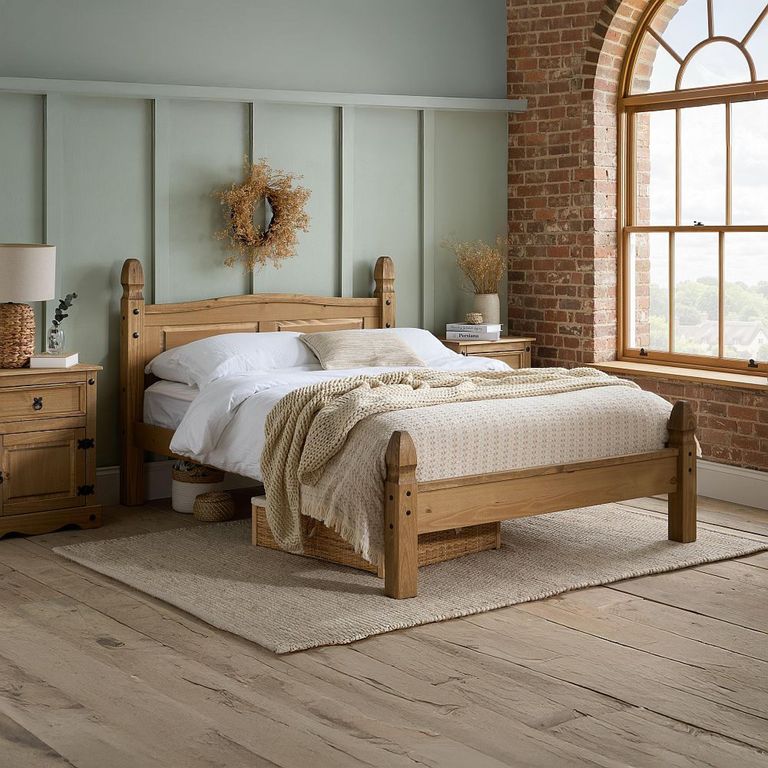
The biggest mistake in a small bedroom is choosing each item separately.
A bed fits against one wall, so it is ordered. A wardrobe fits another, so that follows. Only after delivery does it become clear that the wardrobe door meets the bedside cabinet, a drawer cannot open fully and the bed has to be climbed over from one side.
A better approach is to plan every moving part at the same time. The room does not need to contain the smallest possible furniture; it needs furniture that can be used properly.
Start by measuring the entire bedroom and noting the fixed features. Then explore bedroom furniture with those measurements beside you.
Measure more than the walls
Record the room length and width, but also include:
- Door position and opening direction
- Window width and sill height
- Radiators
- Plug sockets and switches
- Skirting-board depth
- Alcoves and chimney breasts
- Sloping ceilings
- The position of wall lights
- The delivery route from the front door
Measure at several heights if walls are uneven or the room sits beneath the roof. A wardrobe that fits at floor level may meet a sloping ceiling higher up.
Place the bed first
The bed is normally the largest item and the least flexible, so it should lead the plan.
Ideally, leave access on both sides, particularly when two people share the room. In a very compact bedroom, placing one side against the wall may be unavoidable, but consider the daily inconvenience of making the bed and climbing in.
Compare the exact external dimensions of beds. Mattress size and bed-frame size are not the same thing. Upholstered frames, sleigh beds and wide headboards can add a surprising amount to the overall footprint.
Mark the full frame on the floor, not just the mattress dimensions.
Allow for drawers, lids and mechanisms
Storage beds can be extremely helpful, but only if there is room to operate them.
A side-opening ottoman bed needs clear space on its opening side. An end-opening model needs room at the foot. Beds with drawers require enough clearance to pull each drawer out fully; a bedside cabinet or radiator may make one drawer unusable.
Also consider the weight of the mattress and the manufacturer’s instructions for the lifting mechanism. Storage capacity is not valuable if accessing it is awkward.
If the bed has a tall headboard, check the position of windows, shelves and wall fittings before ordering.
Plan the wardrobe with its doors open
A wardrobe does not merely occupy its closed footprint.
Hinged doors swing into the room and need clear space in front. Sliding doors remove that swing, making sliding door wardrobes useful in some tight layouts. However, sliding doors normally reveal only part of the interior at one time and the tracks add to the wardrobe’s construction.
Measure the internal arrangement as well as the outside. A narrower wardrobe with the right combination of rails and shelves may hold more useful clothing than a wider one organised poorly.
Check ceiling height carefully. Allow room for assembly if required, and confirm whether the wardrobe is delivered flat-packed, partially assembled or fully assembled. A piece that fits the bedroom may not fit around the staircase.
Choose bedside furniture after the bed
Bedside cabinets are useful for lighting, glasses, phones and medication, but a matching pair is not compulsory.
In a very small room, one cabinet may be enough. Alternatively, choose different sizes on each side if the available gaps are unequal.
Compare bedside cabinets according to width, depth and height. The top should be comfortably reachable from the bed without obstructing doors or drawers.
A wall shelf can replace a cabinet where floor space is extremely limited, provided it is fitted safely and does not create a head-level obstacle.
Chest of drawers or more wardrobe storage?
A chest works well for folded clothing, but the drawers require clearance in front. Include the depth of a fully opened drawer when testing the layout.
Tall chests of drawers use less floor width, although the top drawers may be less accessible for some users. Wider, lower chests provide a generous surface but occupy more wall space.
Before buying both a wardrobe and a chest, list what each will contain. Adding internal wardrobe shelves or drawers may be more efficient than squeezing another piece into the room.
Tall furniture should be secured according to the manufacturer’s instructions.
Protect the route through the room
The journey from the door to the bed should feel natural. Avoid layouts that require somebody to walk around the bed’s foot, squeeze past a chest and then turn sideways to reach the wardrobe.
Open the bedroom door fully on your plan. Then account for the wardrobe, drawers and storage bed in use.
Try to keep the area immediately inside the room relatively clear. Entering into the side of a wardrobe or tall chest can make the bedroom feel more restricted than it really is.
Do not block radiators or place furniture where it prevents windows from opening safely.
Think about sockets before committing
A layout may appear perfect until you discover that the headboard covers the only convenient socket.
Plan how bedside lamps, chargers, a television or hair-styling tools will be powered. Avoid running extension leads beneath rugs or across walking routes. If additional sockets are required, use a qualified electrician.
Wall-mounted lights can free the tops of small bedside cabinets, but their position should be decided after the bed dimensions are confirmed.
Do not fill every remaining gap
A narrow unused space is not necessarily a problem waiting for furniture. Empty floor around the bed makes dressing, cleaning and opening storage easier.
Avoid ordering a dressing table, blanket box or extra cabinet simply because it technically fits. First ask what function it performs and whether an existing piece can do the same job.
A dressing table may double as a small workstation, but only if there is room for its seat and the arrangement remains comfortable. A blanket box at the foot of the bed is useful only when it does not obstruct the main route.
Make a full-size floor plan
Masking tape is particularly effective in a small bedroom. Mark the bed, wardrobe and chest on the floor, then add their open doors and drawers.
Walk through the arrangement. Pretend to make the bed, select clothes and open the bottom drawer. If another person shares the room, see whether you can move around one another.
This exercise may show that a slightly smaller wardrobe improves the whole bedroom, or that a larger bed still works once unnecessary furniture is removed.
The best small-bedroom layout is not the one that stores the greatest number of objects. It is the one that lets you reach the bed, open the storage and get ready without beginning and ending every day in an obstacle course.