


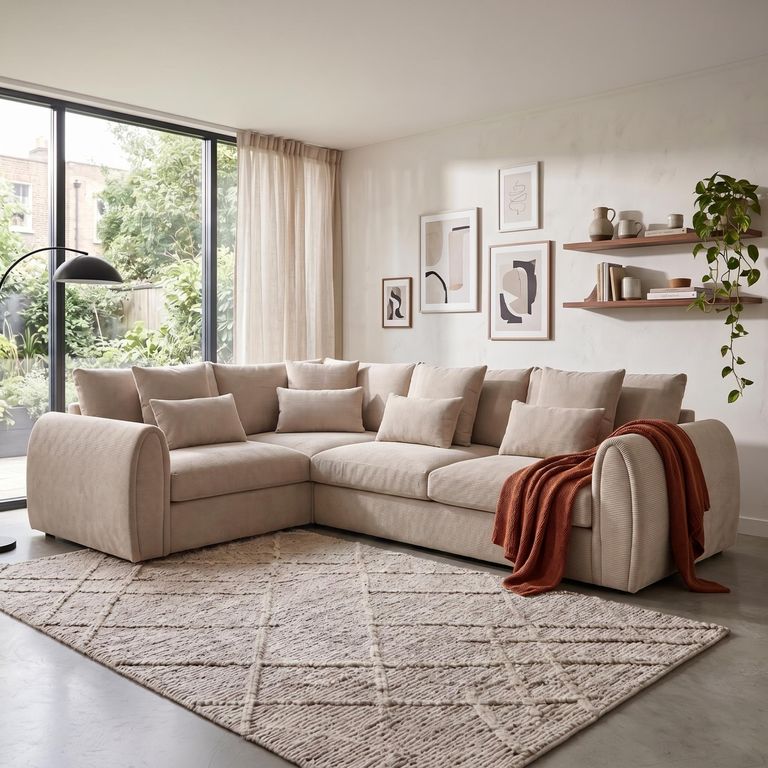
A corner sofa can look just right in a photograph and still be the wrong way round for your living room. The longer section might cross a doorway, cut off the route to the dining area or end up on the opposite side from where you planned to stretch out. It is an easy detail to miss when you are looking at a sofa on a screen rather than standing in the room.
Choosing the correct side takes a few checks. Start with the direction shown on the product page, then look at your room from the same viewpoint and mark out the sofa’s full footprint.
What does left-hand or right-hand mean?
Stand in front of the sofa and face its seats. On CFS’s corner sofa categories, a left-hand sofa has its extended or chaise section on your left from that position. A right-hand sofa has it on your right.
| When you face the sofa from the front | Choose |
|---|---|
| The extended section needs to be on your left | Left Hand Corner Sofas |
| The extended section needs to be on your right | Right Hand Corner Sofas |
Do not make the decision while imagining yourself sitting on the sofa: your left and right will be reversed. Check the photograph and dimension diagram for the individual sofa as well. Some makers describe the side of an arm or a particular section rather than the position of the chaise, so the product’s full layout is the final check.
Picture the sofa in your room before choosing a side
Stand where you would normally enter the living room. Where will people walk to get past the sofa? Which side leads towards a doorway, the kitchen or a patio door? A chaise can work well along a wall or towards a quieter part of the room. It can be awkward when it projects across the only clear route through the space.
Now picture the sofa from the front, as you would see it in a product photograph. If the longer section belongs on the left, start with the left-hand range. If it belongs on the right, start with the right-hand range. This is more reliable than deciding from where you intend to sit.
Think about what will sit around the sofa, too. Leave room to use a Coffee Table without squeezing between it and the seats. Check whether a Side Table will still fit beside the arm. A layout that looks spacious when the room is empty may feel different once those pieces are in place.
Measure both sides, not just the overall width
Corner sofas are rarely described by one useful measurement. Look for the length of each side, the depth of the seats and the depth of any chaise or open end. Two sofas with the same overall width can take up very different amounts of floor space.
Use the product’s dimensions to mark its outline on the floor with masking tape or sheets of paper. If you have an existing sofa, mark where the new one would end rather than assuming its footprint will be similar. Walk through the room as you normally would. Open nearby doors and drawers. Sit down and stand up in the space you have marked.
Before ordering, check:
- The full length of both sides. Will either end run into a door, radiator or another piece of furniture?
- The chaise or open-end depth. Does it project into a walking route?
- Doors and windows. Can they open and be used comfortably?
- Delivery access. Check doorways, narrow hallways, stair turns and lifts, as well as the room itself. Find out whether the sofa arrives in separate sections.
Keep the measurements for the exact model you want to buy. A photograph cannot show the clearance accurately, and sizes can differ even between sofas with a similar shape.
Fixed, reversible or modular: can you change the side later?
A fixed left-hand or right-hand sofa has a set configuration. If you choose the wrong side, moving it to another wall will not change the direction of its extended section.
Some chaise sofas are reversible, meaning the long section can be assembled on either side. Others only look similar but have fixed components. Check the individual specification before assuming you can swap the arrangement. A sofa described as modular may offer more layout choices, but the number and type of sections determine what is possible. Our Modular Sofas range is a useful place to compare those options.
If you expect to move house or change the room regularly, flexibility may be more useful to you than a fixed layout. If the sofa has one permanent position, concentrate on getting the fit and orientation right for that spot.
The final check before you order
Go back to the individual product page with your room measurements beside you. Confirm the model name and its left-hand or right-hand option. Look at the main photograph and any dimension drawing; check that the extended side matches the space you marked on the floor. Confirm the dimensions of the exact version selected, particularly if the range offers several sizes or configurations.
If the label, photograph and drawing do not appear to agree, ask CFS to confirm the orientation of that specific product before placing the order. A quick check is better than guessing from an abbreviation such as LHF or RHF.
Ready to compare layouts? Browse all Corner Sofas, then narrow your choice to the side that works in your room.
Frequently asked questions
Is a left-hand corner sofa left-hand when I sit on it?
For the CFS left-hand category, view the sofa from the front, facing the seats. The extended section is on your left from there. Always confirm the individual product photograph and specification, as makers may use orientation labels differently.
Can I turn a right-hand corner sofa into a left-hand one?
Only if the particular sofa is designed to be reversible or can be configured that way using its sections. A fixed right-hand sofa cannot usually be changed by moving its cushions. Check the assembly and product details before buying.
What if both orientations fit my room?
Choose the layout that leaves the easier walking route and places the chaise where you will actually use it. Mark out both options on the floor and live with each outline for a day if you are uncertain.
Does a corner sofa arrive in one piece?
It depends on the model. Some arrive in sections that connect during assembly, while others have larger fixed parts. Check the product’s delivery and assembly information, then measure the route into your home as well as the final position.